The changing landscape of global industry presents major opportunities for India and ASEAN. US–China trade tensions, rising geopolitical risks, and the need for multinational companies to diversify their supply chains have driven the China+1 strategy. Companies are not necessarily leaving China, but are beginning to locate part of their production capacity in other countries to reduce dependence on a single location.
However, a fundamental problem remains: industrial relocation does not automatically create regional economic integration. India and ASEAN countries may both attract investment but still fail to build complementary production ecosystems. If each country offers only tax incentives, subsidies, and competitive wages to compete for the same investors, the result could be a subsidy race rather than an improvement in regional competitiveness. Therefore, the China+1 strategy needs to evolve into a shared India–ASEAN production strategy.
ASEAN–India economic relations have developed through their dialogue partnership since 1995 and the ASEAN–India Trade in Goods Agreement (AITIGA), which was signed in 2009 and entered into force in 2010. In 2025, both sides continued reviewing AITIGA to make the agreement more effective and responsive to changes in global trade.
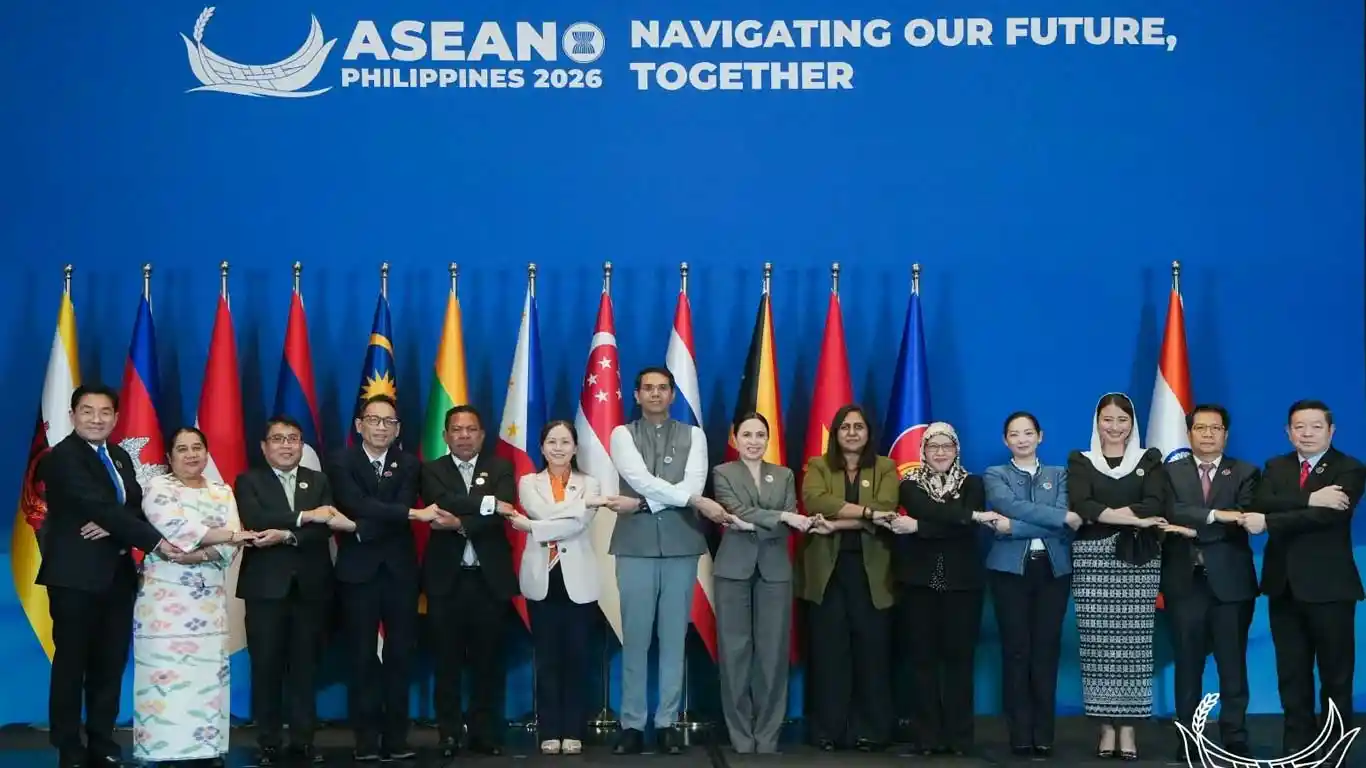
This development continued in 2026. At the ASEAN–India Economic Ministers’ Consultation in Manila in September, both sides discussed trade, investment, and the revision of AITIGA. Bilateral trade in goods reached US$128.38 billion in India’s 2025–2026 fiscal year, while ASEAN accounted for approximately 10.55% of India’s total global trade. These figures demonstrate that the relationship has a significant economic foundation, rather than being based solely on diplomatic proximity.
Nevertheless, substantial trade does not guarantee an integrated division of production roles. The next challenge is to ensure that investment, technology, components, skilled labour, and markets from both regions are interconnected.
Industrial Relocation
Investment data show that supply chain transformation is not merely a talking point. According to the ASEAN Investment Report 2025, foreign direct investment (FDI) inflows into ASEAN increased by 8% to US$226 billion in 2024, while global FDI flows declined by 11%. ASEAN’s manufacturing investment surged by nearly 150% to US$44 billion. Electronics, electric vehicles, pharmaceuticals, and the digital economy have become important parts of this transformation.
Vietnam, Thailand, Malaysia, and Indonesia offer different production capabilities. Vietnam is developing as an electronics manufacturing base; Thailand has an automotive ecosystem; Malaysia has strengths in semiconductors and electronics; while Indonesia possesses critical mineral resources for batteries and electric vehicles.
India is also making progress. According to the Indian Ministry of Commerce, its electronics production increased from ₹1.9 trillion in 2014–2015 to ₹11.3 trillion in 2024–2025. Electronics exports rose to ₹3.27 trillion over the same period. Mobile phone production and manufacturing incentive policies have been part of this transformation.
However, these figures must be interpreted carefully. Increased investment in India and ASEAN does not entirely represent direct relocation from China. Some of it reflects new capacity expansion, investment to serve domestic markets, or diversification that retains production facilities in China. Thus, China+1 is not a simple transfer of industry but the formation of a more geographically distributed production network.
Why India and ASEAN Need to Cooperate
The theory of comparative advantage explains that countries benefit when they specialise according to their relative capabilities and costs. However, in the modern economy, advantage is no longer determined solely by final products. Countries also compete through their positions in global value chains.
A study by the Economic Research Institute for ASEAN and East Asia (ERIA) shows that ASEAN has relatively strong connections to global production networks, while India’s integration into global value chains still has room for improvement. The study highlights the importance of cross-regional investment and identifying manufacturing complementarities.
From the perspective of regional production network theory, economic benefits are greater when companies can combine the advantages of different locations. India has a large domestic market, technological capabilities, and a broad industrial and labour base. ASEAN offers supplier networks, ports, industrial zones, export experience, and access to various markets across East Asia and the Pacific.
If both sides operate independently, they risk duplicating investments and competing in the same products. Conversely, if they are connected, components can be produced in one country, processed in another, assembled at the most efficient location, and marketed through regional trade networks. This is the difference between merely attracting investment and building collective competitiveness.
Building a Shared Production Strategy
First, India and ASEAN need to develop a cross-regional supply chain map. This mapping should identify priority industries, missing suppliers, technological requirements, and the most competitive production stages in each country. Electronics, semiconductors, electric vehicle batteries, pharmaceuticals, and industrial machinery are suitable starting sectors.
Second, the revision of AITIGA should be directed towards facilitating trade in intermediate goods and components. Simplifying rules of origin, customs procedures, technical standards, and certification would help companies distribute production processes across borders without facing excessive administrative costs.
Third, investment cooperation must go beyond individual countries’ investment promotion efforts. Governments can establish regional supplier forums that bring together multinational companies, local industries, financial institutions, and research centres. The objective is not merely to attract factories but to strengthen the capacity of local companies to become part of international supply chains.
India needs to strengthen manufacturing competitiveness, improve regulatory certainty, create opportunities for technology partnerships, and leverage its domestic market to achieve production scale. India can also serve as a centre for design, engineering, industrial software, and the production of selected components.
ASEAN needs to strengthen connectivity among its member states, harmonise standards, and connect industrial zones and ports with Indian supplier networks. Indonesia can contribute through critical minerals, battery materials, and downstream industrial development. Malaysia can strengthen semiconductors and electronics, Thailand automotive manufacturing, and Vietnam electronics manufacturing and export networks.
ASEAN itself is not a uniform economy. Therefore, the division of roles should be based on each country’s capabilities rather than rigid political quotas. India and ASEAN must also involve the private sector as the main driver, while governments ensure fair competition and that investment benefits reach workers and local industries.
From Competition to Complementarity
China+1 offers an opportunity, but that opportunity will not endure through investment incentives alone. Companies will choose locations that offer productivity, policy certainty, quality suppliers, infrastructure, and market access. India and ASEAN do not need to build a production bloc that is closed to China. Instead, they should build a more resilient, open, and diversified network, giving companies more options without sacrificing efficiency.
Ultimately, the measure of success is not how many factories have been moved out of China. It is how far India and ASEAN can improve value addition, productivity, job quality, technology transfer, and industrial competitiveness.
China+1 should be a starting point, not the final destination. If India and ASEAN can transform investment competition into a shared production strategy, they will not only become alternatives to China but also establish one of the most important manufacturing centres in the Indo-Pacific economy.